Before I talk about the ocean-themed battlemat available as a free download, I’m going going to tell you about how I came to create these playing surfaces I call Slagmark. A few years ago I migrated to playing miniature games on a hex grid. I did this because we wasted too much time arguing about a quarter inch here or there and arguing about firing arcs. Hexes eliminate all of that completely.

The old Geohex system didn’t quite work for me because of the scale of the hex grid. I found the 1 inch hexes too small and the 12 inch hexes too big.
Instead, for land-based battles like those in Rome & Her Rivals, I started using Kalistra‘s Hexon system. The tiles are beautiful, and the pattern doesn’t intrude to badly into game aesthetics. I really had a lot of fun using Kalistra. But I eventually moved on because they didn’t quite fill my bill.
Here’s what I didn’t like about them. Firstly, dice always seem to end up cocked in the seams where the tiles meet (and there are a lot of seams). That flaw is easily solved by using a dice tray.
Secondly, a tabletop full of terrain fits into 2 boxes with each box being about 8″ x 10″ x 12″. That’s not bad, but when you have a lot of miniature and terrain, you learn that the most expensive thing about the hobby is the real estate you need to store your stuff. Neither of those were killer flaws, but there was one problem that I couldn’t quite overcome.

The issue that divorced me from Kalistra was that the size of the hexes is 100 mm. 100 mm just about perfect. It’s close to 4 inches (a common unit of movement in gaming). But the problem is that the standard movement tray is about 105 mm. So when you had a full table of figures, the trays didn’t quite fit right into the hexes.
So I created Slagmark. (Slagmark means battlefield in Icelandic.) My goal was to make something affordable that solved the problems I had with Kalistra. After a lot of research and failed experiments, I settled on a printed textile with graphics that I myself made. I had them printed by Amazon sellers who were marketing “custom draperies.”
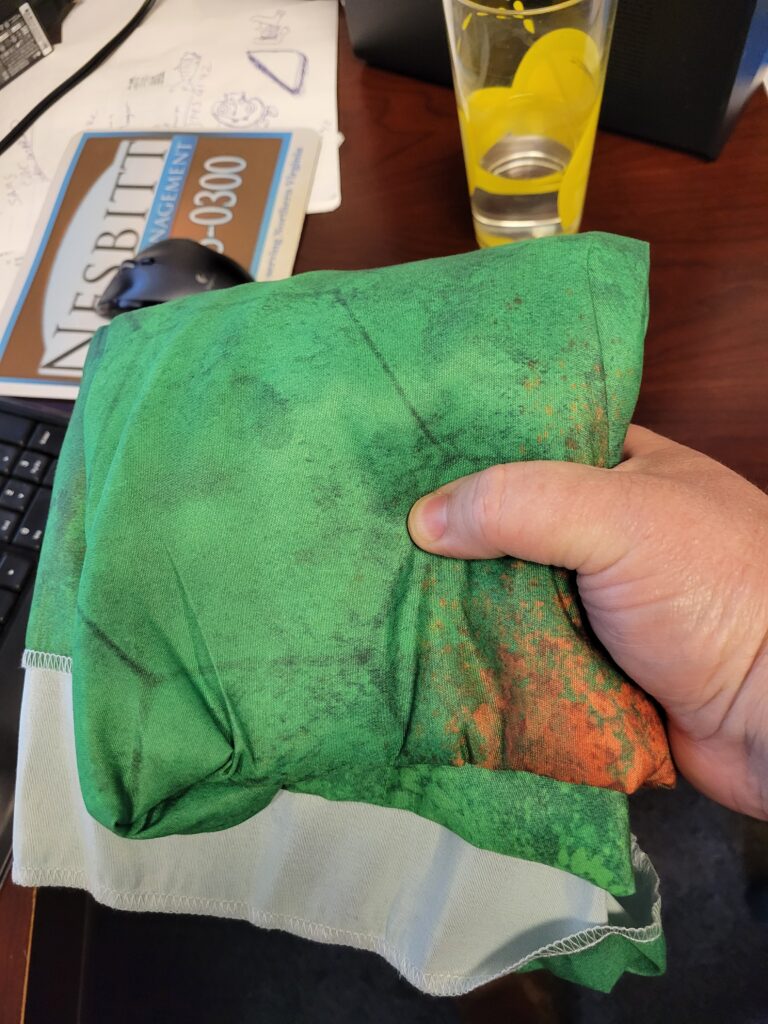
One of the first benefits that I found was that I could just about fit a 5 foot by 8 foot playing surface in my fist. That made it easy to store, easy to carry, easy to set-up. Secondly, there are no grooves for dice to land in. And thirdly, I could make the hexes just big enough to comfortably fit a movement tray.

I made several versions for various types of battlefields. In the meantime, I was also working (for years) on a game I call Flattops & Floating Fortresses.
Like Slagmark, Flattops & Floating Fortresses sprung from my frustrations with the limitations of a product I was already using. I found a lot of problems with Axis & Allies War at Sea, so I started tinkering adding and changing until I had a fully-formed stand-alone game that did not obsolete my existing collection of miniatures and data cards. The development of that game is for another day.
The point is that I was playing the game on a commercially available battlemat that I used for some air and sea games.

I had a lot of fun by putting 2 of the mats side by side. I think this product is serviceable. But after a while, I started to dislike the graphic. For one thing the hex was a little too intrusive. It seemed to diminish the game’s aesthetics. So since I had already created Slagmark, and then I realized I need to make a marine version.

I’ve gotten a lot of compliments on my marine hex map, but that’s because (I think) I learned a lot from making Slagmark battlefields. I came to realize that the board would be much more attractive if the hexes weren’t so obvious. So I made the hexes in such a way that they are easy to see when you are looking at a particular hex, but when you are looking at the entire table, they sort of disappear. You can get a good idea of how this effect works in the picture above.
At any rate, I could print these and sell them, I suppose. But instead I’ve decided to give the files away and let you print your own.
I’ve included in every version of Flattops & Floating Fortresses a free download of this file. It’s 60 inches by 90″ inches and it’s at 150 dpi. That means the resolution is about half of what you see in typically in printed media, but about twice as much resolution as most computer monitors.
Here’s what Flattops & Floating Fortresses products are available at the time of this article:
- Flattops & Floating Fortress core — Includes critical hit cards, military decorations (situational bonus cards) and capabilities (describing unique capabilities of some vessels), plus downloads of the core rules, quick reference and the Slagmark marine field.
- Phase Deck — This is a deck used to keep track of the current phase. Each card also contains notes on how to manage each phase. This is the easiest way to learn the game and by far the best way to run a game. This also includes reference cards for search checks, fire reference and more. With your purchase you also get downloads of the core rules, quick reference and the Slagmark marine field.
- Coral Sea Carrier Clash scenario pack — Technically this is still in pre-release, but you can still purchase this now. This scenario has 128 cards in total. These include threat (data) cards for dozens of Allied and Axis ships that were involved in the Battle of Coral Sea, as well as more Capability cards and unfounded threats to mask hidden movement. Of course, with your purchase you also get downloads of the core rules, a Coral Sea reference book, a quick reference and the Slagmark marine field. The Coral Sea reference book is 99% complete and should be available in the next day or so.
The Flattops & Floating Fortresses reference is finished. Also, coming soon is the Coral Sea Carrier Clash scenario reference. Both books are lavishly illustrated and fun to read. Both will be available on Amazon very soon.

Leave a Reply